
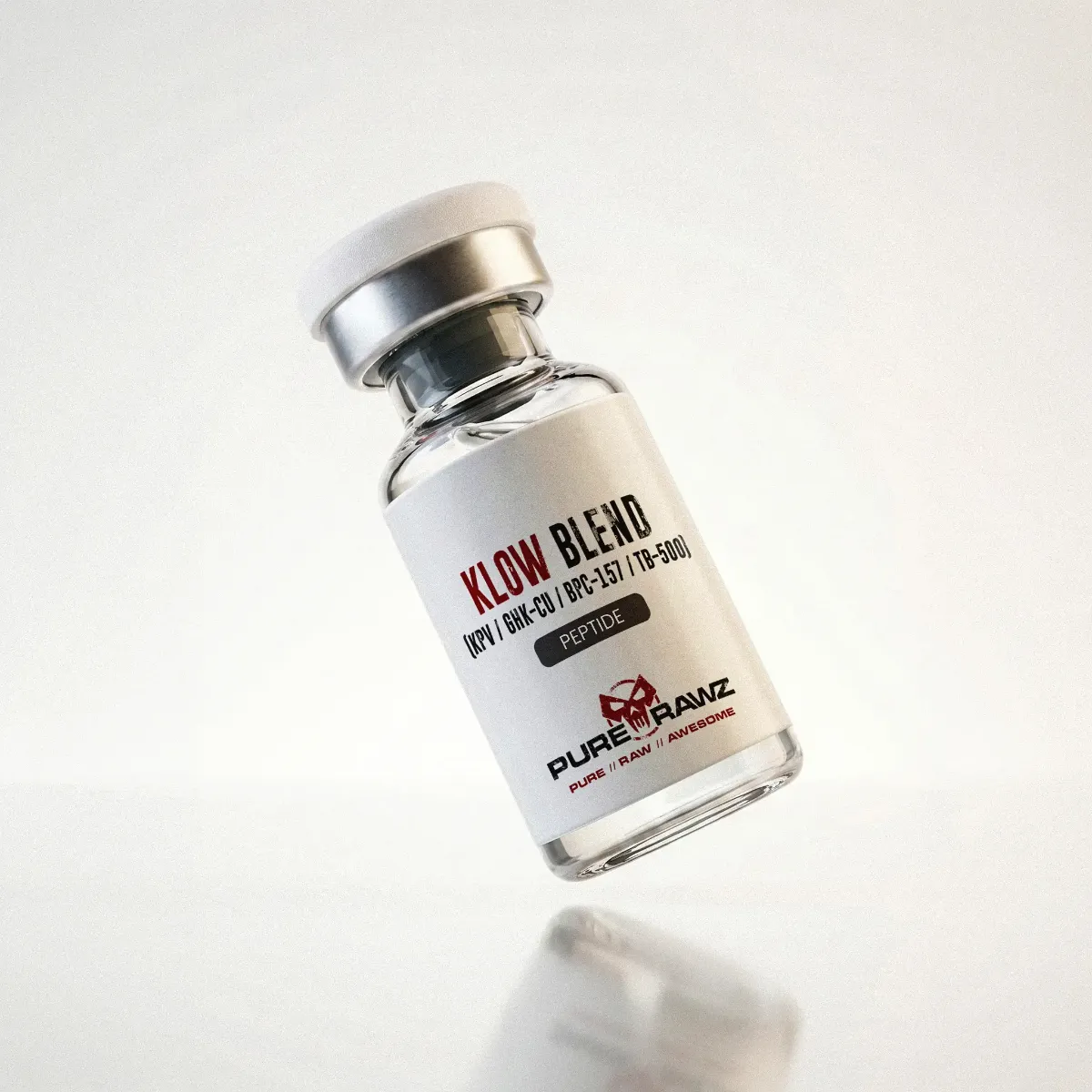
Description
KLOW blend combines KPV, GHK-Cu, BPC-157 and TB-500 in one product, sold as freeze-dried blend vials. Every batch is tested for 99% purity or better, and it’s sold for laboratory research only.
Inside KLOW blend
KPV
KPV is the tripeptide lysine-proline-valine, the C-terminal end of alpha-melanocyte stimulating hormone. It keeps alpha-MSH’s anti-inflammatory activity without the pigment effects.
Alpha-MSH calms inflammation through melanocortin receptors. KPV is its last three amino acids and keeps much of that anti-inflammatory activity.
GHK-Cu
GHK-Cu is the tripeptide glycyl-histidyl-lysine bound to a copper ion. GHK occurs naturally in human plasma, saliva and urine, and its levels fall with age.
GHK binds copper tightly and can deliver it to cells. Copper is a cofactor for lysyl oxidase, the enzyme that cross-links collagen and elastin, and for antioxidant enzymes.
BPC-157
BPC-157 is a 15-amino-acid peptide based on a fragment of body protection compound, a protein first found in gastric juice. It’s one of the most widely studied research peptides, almost entirely in rodents.
Nobody has pinned down a single receptor for BPC-157. Lab studies point to several pathways: it raises VEGF receptor expression, which feeds blood vessel growth, it interacts with the nitric oxide system, and it increases growth hormone receptor levels in tendon cells.
TB-500
Thymosin beta-4 is a 43-amino-acid protein found in nearly every cell, where it binds actin and helps control cell movement. TB-500 is the name used for synthetic thymosin beta-4 and for a short fragment of its active region.
Thymosin beta-4’s main job is holding on to G-actin, the building block of the cell’s internal scaffolding. By controlling how much actin is free to polymerize, it controls how cells move and change shape.
Why KLOW blend combines these compounds
Labs pair these compounds because each works through a different pathway, so combining them covers more of the system in one study. A fixed mix also means one product, one label and no drift between separate containers.
Research behind KLOW blend
Dalmasso and colleagues reported in Gastroenterology (2008) that KPV reduced inflammation in mouse colitis models and was taken up through PepT1.
Loren Pickart, who first isolated GHK in 1973, has published reviews of its effects on collagen synthesis, wound contraction and gene expression in cell and animal studies.
Most of the work comes from Predrag Sikiric’s group at the University of Zagreb. Their rodent studies report faster healing of tendon, ligament, muscle and gut injuries, and Mikus and colleagues described improved burn wound healing in mice.
For the original studies, start with this PubMed search for KPV, GHK-Cu and BPC-157.
Options and prices
It comes in one option (Peptide Blend, 80mg (10mg + 50mg + 10mg + 10mg)), priced at $189.99.
Because the parts are dried together in one vial, the ratio stays the same in every draw. That’s the main reason labs buy a blend instead of mixing separate vials.
Study design notes
When labs combine compounds, they usually keep the total peptide amount and the mixing volume the same across groups. That way any difference comes from the combination, not the handling.
Record the ratio on every label, especially once vials are mixed.
A clean combination study has at least four groups: vehicle, compound A, compound B and A plus B. That’s the only way to tell whether the mix does more than either part.
Mixing and concentration
For the 80mg vial, the concentration depends on the volume of water:
- 2mL of bacteriostatic water gives 40mg/mL
- 3mL of bacteriostatic water gives 26.67mg/mL
- 5mL of bacteriostatic water gives 16mg/mL
Add the water slowly along the inside of the vial and roll it gently until the powder dissolves. Shaking can damage peptide chains.
KLOW blend specifications
- Contains: KPV, GHK-Cu, BPC-157 and TB-500
- Forms: peptide blend
- Size: 80mg (10mg + 50mg + 10mg + 10mg)
- Purity: 99% or higher, verified by first- and third-party testing
- Use: laboratory research only
How we test each batch
Every batch is tested before it goes on sale. Identity is checked by mass spectrometry, and purity by HPLC, with a target of 99% or higher.
Each container is labeled with the product, the amount and the batch number. Email us that number and we’ll send the certificate of analysis for your batch.
Keeping it fresh
Keep sealed vials in a freezer at -20°C or a fridge at 2 to 8°C, away from light. After mixing, store the vial in the fridge and use it within about four weeks. Note the batch number and the date you opened it in your lab records.
Working with it safely
Treat it as a lab chemical. Gloves and safety glasses are the minimum, and a clean, uncluttered workspace cuts down on mix-ups.
Store prepared solutions apart from untouched stock, and record who mixed what and when.
Supplies to have on hand
- Bacteriostatic Water for reconstitution, or Sterile Water if you’ll use the whole vial at once
- sterile insulin-type syringes or pipettes for measuring
- alcohol swabs for the vial stopper
Related products
- Sermorelin + GHRP-6 Blend, combining Sermorelin and GHRP-6
- IGF-LR3 + BPC-157 Blend, combining IGF-1 LR3 and BPC-157
- Pulse Bundle, combining CJC-1295, Ipamorelin and Sermorelin
- Ipamorelin + Epithalon + CJC-1295 No Dac Spray, combining Ipamorelin, Epithalon and CJC-1295
- Sermorelin + Ipamorelin Blend, combining Sermorelin and Ipamorelin
See the rest of our peptide blends and bundles and healing and recovery peptides for more options.
KLOW blend questions
How should I store it?
Follow the storage section above. In short: cold and dark for freeze-dried vials, room temperature and dry for capsules, tablets, powders and liquids, unless the label says otherwise.
Is KLOW blend in stock?
Yes. It’s in stock and ships from our warehouse after your order clears.
Does it come with a certificate of analysis?
Yes. Every batch is tested, and we’ll email the certificate of analysis for your batch number on request.
Can it be used in people or animals?
No. It’s sold for laboratory research only and isn’t approved for human or veterinary use.
What do I mix it with?
Most labs use sterile bacteriostatic water. Add it slowly down the side of the vial and swirl gently until the powder dissolves. Don’t shake it.
What’s in KLOW blend?
KPV, GHK-Cu, BPC-157 and TB-500. The section above covers each one.
Buy KLOW blend from Pure Rawz
KLOW blend is in stock at $189.99. Add it to the cart and check out in a couple of minutes.
Need more for the same project? Have a look at our peptide blends and bundles and healing and recovery peptides.
For laboratory research use only. Not for human or veterinary use. These statements have not been evaluated by the FDA.

Reviews
There are no reviews yet.