
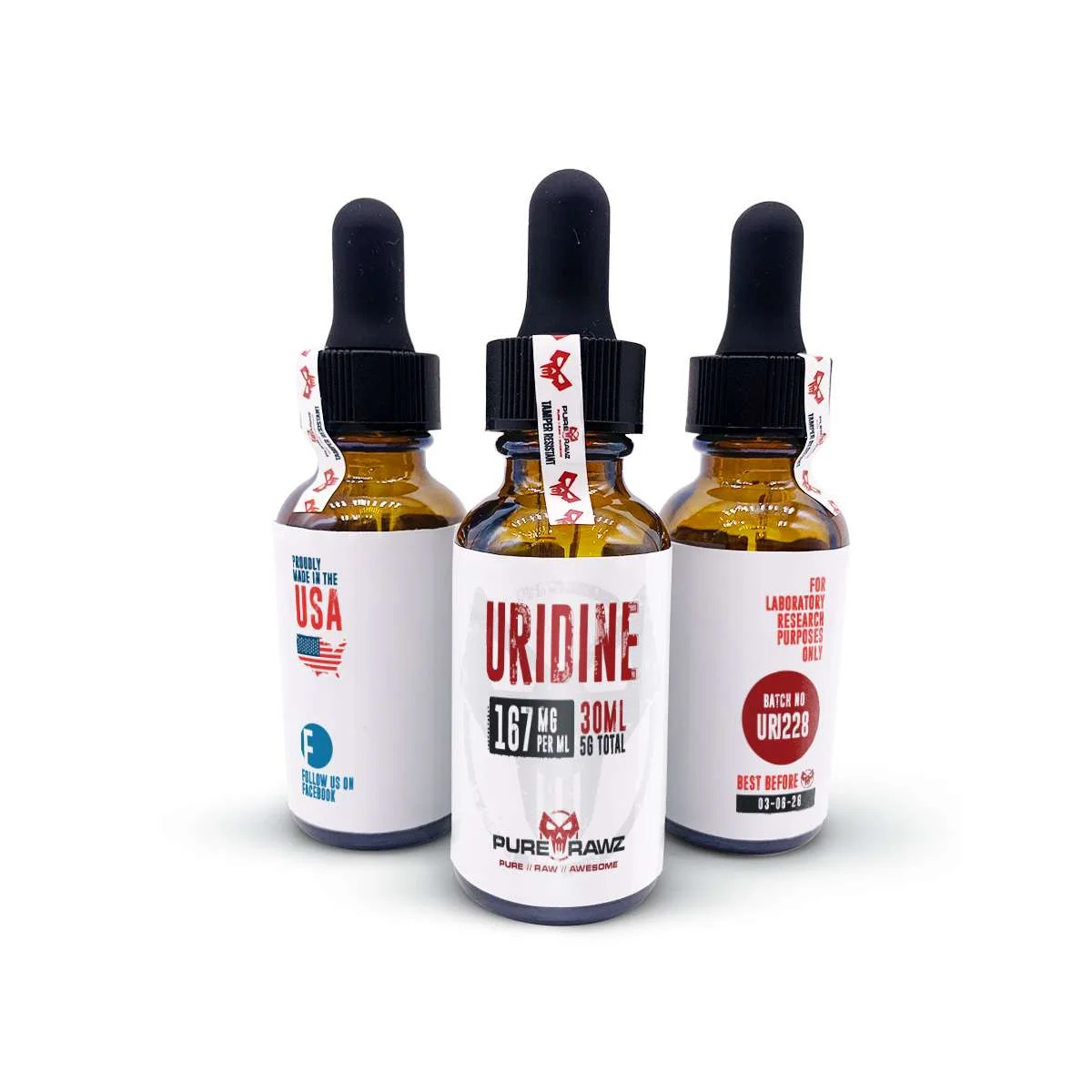
Description
Uridine Overview
Uridine (CAS: 69-75-0) is a pyrimidine nucleoside consisting of uracil bound to a ribose sugar. The compound participates in nucleotide metabolism and serves as a precursor for uridine nucleotides involved in nucleic acid biosynthesis and phospholipid metabolism.
Chemical Properties
| Property | Value |
| CAS Number | 69-75-0 |
| Molecular Formula | C9H12N2O6 |
| Molar Mass | 244.20 g/mol |
| IUPAC Name | O3′-methyl-uridine |
Uridine is classified as a ribonucleoside that contributes to intracellular pools of uridine triphosphate (UTP) and cytidine triphosphate (CTP) through nucleotide salvage and phosphorylation pathways.
Molecular and Biochemical Activity
Uridine participates in nucleoside salvage pathways where it undergoes phosphorylation to form uridine monophosphate (UMP), which may subsequently convert to UDP and UTP through enzymatic processes mediated by nucleoside kinases.
UTP functions as a substrate in multiple cellular pathways, including:
- RNA synthesis through ribonucleotide incorporation
- Glycosylation reactions mediated by UDP-activated sugar intermediates
- Phospholipid biosynthesis pathways involving cytidine diphosphate-activated intermediates
Uridine nucleotides also participate in intracellular signaling mechanisms through purinergic receptor families such as P2Y receptors, which recognize extracellular nucleotides including UTP and UDP.
Membrane Phospholipid Pathway Involvement
Uridine-derived nucleotides contribute to phosphatidylcholine biosynthesis through cytidine-dependent phospholipid synthesis pathways. In these pathways, CTP functions as a cofactor in the generation of CDP-activated intermediates that participate in membrane phospholipid assembly.
Nucleic Acid Synthesis
Uridine serves as a fundamental nucleoside component of RNA. During transcriptional processes, uridine triphosphate (UTP) is incorporated into RNA polymers by RNA polymerases as part of ribonucleotide polymerization.
Cellular Transport
Uridine transport across cellular membranes occurs via nucleoside transporter proteins, including equilibrative nucleoside transporters (ENT) and concentrative nucleoside transporters (CNT). These transporter systems regulate intracellular nucleoside availability and nucleotide synthesis.
Why Choose Purerawz for Uridine?
Buy Uridine for laboratory research use from our online shop. At Purerawz, we provide high-quality reference materials. Each research compound comes with a Certificate of Analysis for verification of purity and concentration.
Disclaimer
This information is for educational purposes only and not medical advice. Products are for research use only. Research must follow IRB or IACUC guidelines. Verify information independently before purchasing. By ordering, you agree to our Terms and Conditions. If you are not 100% satisfied with the product you received, please contact us at support@purerawz.co
Reference Links
- Ding, C., Zuo, R., Liao, Q., Guo, Z., He, J., Ye, Z., & Liu, G. (2025). Uridine alleviates the aging of alveolar epithelial cells in idiopathic pulmonary fibrosis through the Keap1-Nrf2 signaling pathway. Scientific Reports, 15(1), 22952. https://doi.org/10.1038/s41598-025-04053-w
- Feagin, J. E., & Stuart, K. (1988). Developmental aspects of uridine addition within mitochondrial transcripts of Trypanosoma brucei. Molecular and Cellular Biology, 8(3), 1259-1265. https://doi.org/10.1128/mcb.8.3.1259
- Lapointe, C. P., & Wickens, M. (2013). The nucleic acid-binding domain and translational repression activity of a xenopus terminal uridylyl transferase. Journal of Biological Chemistry, 288(28), 20723-20733. https://doi.org/10.1074/jbc.m113.455451
Reviews
There are no reviews yet.